
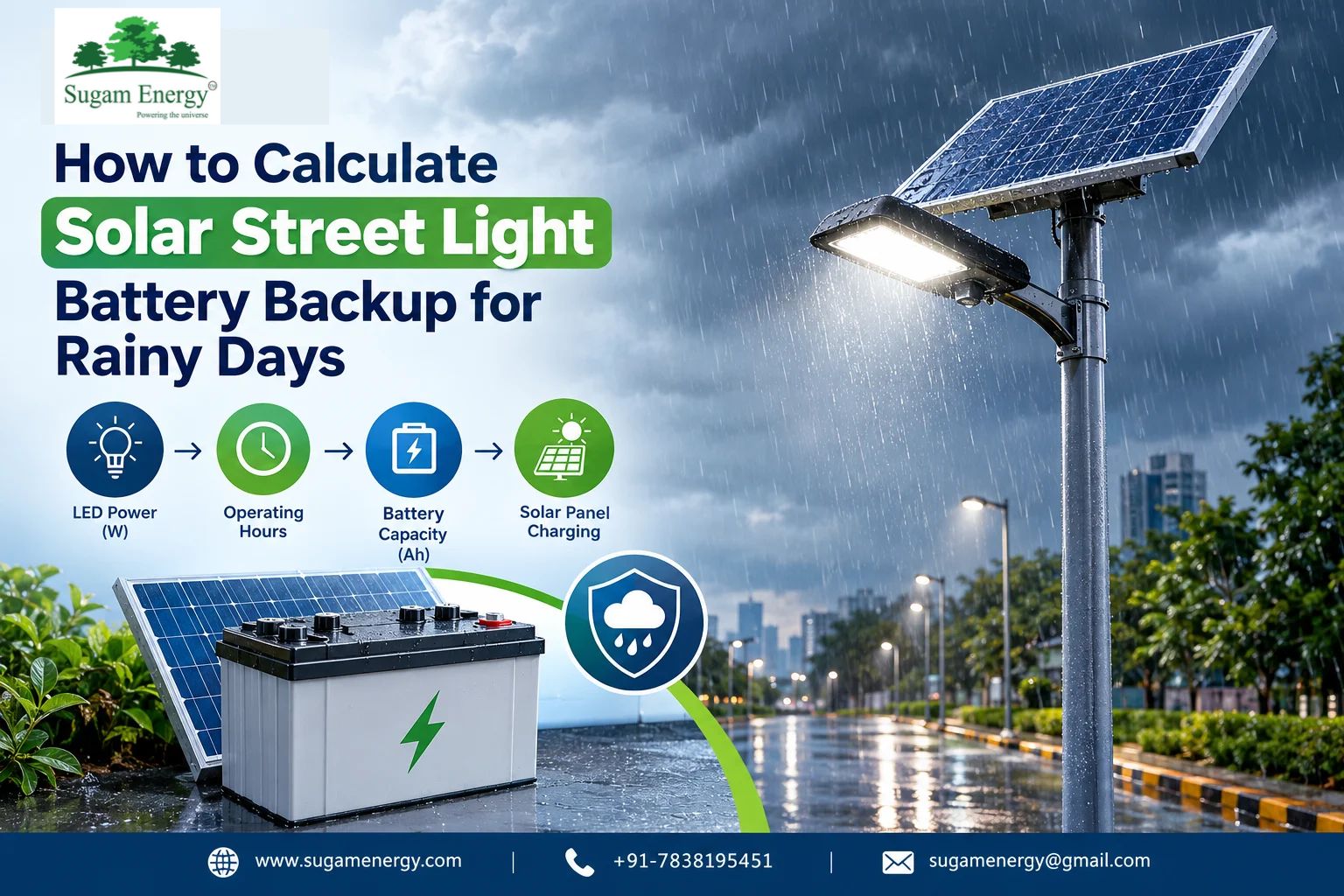
Solar street lights work to ensure lighting outdoors without reliance on the conventional power supply grid. Nonetheless, the monsoon period brings in cloudy skies as well as consistent rain which lowers the output from the solar panels, but the creation of battery backup is an essential consideration. Selecting a reputable Solar Street Light Manufacturer from Sugam Energy will ensure the lighting of streets, residential complexes, industrial complexes, and other places.
How to Calculate Solar Street Light Battery Backup for Rainy Days?
1. Calculate the Daily Power Consumption:
The first step is to determine how much energy the street light consumes every night. This depends on the LED wattage and the number of operating hours.
Formula:
Daily Energy Consumption (Wh) = LED Power (W) × Operating Hours
This calculation provides the minimum energy requirement that the battery must support.
2. Determine the Required Backup Days:
On days where there is rain, the solar panels may produce fewer amounts of energy compared to normal. The battery needs to hold adequate amounts of energy that can make the light work for many consecutive days.
The number of days depends on the prevailing weather conditions and the number of days without much sunlight.
3. Calculate the Required Battery Capacity:
Battery capacity is expressed in ampere-hours (Ah), whereas energy is expressed in watt-hours (Wh). The calculation of battery capacity depends on factors such as the system voltage, available battery capacity, and losses during conversion.
Formula:
Required Battery Capacity (Ah) = Daily Energy Consumption × Backup Days ÷ (Battery Voltage × Usable Depth of Discharge × System Efficiency)
4. Check Solar Panel Charging Capacity:
A larger battery alone cannot guarantee that lighting can function properly in case the solar panel does not generate sufficient energy for charging the battery. In the rainy season, there may be less sunlight available and hence less energy generated daily.
It is important to determine how much energy the panel generates, number of peak sun hours, energy losses in the system, and the energy needed to run the light and charge the battery. The solar panel should cater to the needs at night time and also when there is no sunlight.
5. What Should You Check Before Buying Solar Street Lights?
Consider the following important factors before choosing a system:
- Battery Technology: Test for available capacity, cycle life, and temperature tolerance.
- Weather Protection: Make sure the battery case and electronics are designed for the weather conditions.
- Smart controls: Using dimming control or motion detection lowers power usage when full brightness is not needed.
- Battery Management: Make sure that in the case of Lithium-based batteries, there is proper battery management for the battery pack.
- Conditions of the Project: Take into account the pattern of monsoons, location of installation, and light intensity.
A good Solar Street Light Manufacturer would be able to match the battery size and panel specs with the project needs.
Conclusion:
For calculating the battery backup for solar street light batteries for the rainy season, you must calculate the night consumption of energy, backup time, available battery capacity, and charging efficiency. Collaboration with a Solar EPC Company such as Sugam Energy can assist organizations and infrastructure providers in making such calculations. The purpose is very clear: to make sure that your lights remain operational even during continuous bad weather.
Frequently Asked Questions (FAQs)
This typically means that you add 20% more capacity when determining how much solar energy you need, although this percentage will vary depending on other factors.
Your solar panel can produce about 10-25% of its maximum power capacity during cloudy weather.
Solar panels create electricity through daylight in rainy weather; however, the amount of energy produced in rainy weather is less than that produced in sunny weather.
On average, a solar light takes about 6-8 hours of sunshine to be fully charged.